
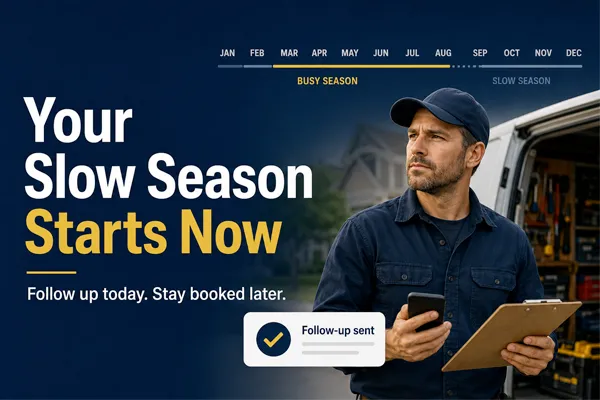
Why Your Slow Season Starts in Your Busiest Month (And What to Do About It)
Every contractor in the Richmond area knows the feeling.
Spring hits. The phone starts ringing. You've got jobs stacked up two weeks out. Estimates every morning, crews running all day, invoices piling up on the kitchen table at night. It's controlled chaos and you love it, this is what you built the business for.
You're so busy you can barely breathe.
And that's exactly when the problem starts.
The Trap Nobody Talks About
Here's something that took a lot of local contractors years to figure out, usually the hard way.
When you're slammed, and I mean really slammed, juggling three jobs at once, dealing with suppliers, managing your guys, handling callbacks, your marketing goes completely dark. Not on purpose. There's just no time. The Facebook page goes quiet. The follow-up texts to old customers never get sent. The estimate you did two weeks ago for that guy in Mechanicsville who said "let me think about it"? You never followed up.
You tell yourself: I don't need to worry about marketing right now. I've got more work than I can handle.
And that's true. In May.
But then August hits. Or November. The phone gets quieter. Jobs start spacing out. You've got a gap in the schedule that wasn't there three months ago, and suddenly you're wondering where all the work went.
Here's where it went: you stopped planting during the harvest.
The slow season you're experiencing in the fall didn't start in the fall. It started back in May when you got busy and went dark. The leads you didn't follow up on went to competitors. The customers you didn't stay in touch with forgot your name by the time they needed you again. The referrals that could have come from that Mechanicsville estimate never materialized because you never circled back.
The slow season was baked in months earlier. You just didn't feel it yet.
This Isn't a Discipline Problem. It's a Bandwidth Problem.
Now before anyone feels called out, this isn't about being lazy or not caring. Every contractor I've seen fall into this pattern is one of the hardest working people you'll ever meet.
The problem isn't work ethic. The problem is that there are only so many hours in a day, and when you're running a small home service operation in Chesterfield or Henrico or Hanover County, you are the business. You're the estimator, the crew chief, the quality control, the bookkeeper, and the customer service department all rolled into one person.
When things get busy, something has to give. And what always gives first is the stuff that doesn't feel urgent, like following up with a lead from last Tuesday or sending a check-in message to a customer you did a job for in March.
Those things feel like they can wait.
And they can... until they can't.
The Customer Who Almost Called You Back
Let me tell you about Mike.
Mike's a painter. Works mostly in the Short Pump and West End area, nice neighborhoods, good jobs, lots of referral potential. He built his business almost entirely on word of mouth and he's proud of that.
A few summers ago, Mike had his best season ever. Booked solid from April through July. More work than he'd ever had. He was turning jobs down.
Then September came and the phone basically stopped.
He started looking back, trying to figure out what happened. And he realized something uncomfortable: he had 14 customers from that summer who had mentioned, in conversation, on the job, or in a text, that they had another project coming up. Another room. The exterior. The deck. Something.
He never followed up with a single one of them.
Not because he didn't care. Because by the time July rolled around he was exhausted, he had three jobs finishing at the same time, and those follow-up texts just never happened.
Those 14 conversations were $40,000 to $60,000 in potential work. Work that probably got done by someone else. Not because that someone else was better than Mike, just because they were there when the homeowner finally pulled the trigger.
Mike told me: "I didn't lose those jobs in September. I lost them in June when I was too busy to stay connected."
That stuck with me.
The Feast-or-Famine Cycle Is Real... And It's Not Seasonal
A lot of contractors just accept this as the nature of the business. Busy season, slow season. It's just how it goes.
But here's the truth: the feast-or-famine cycle isn't a seasonal reality for most home service businesses. It's a follow-up problem wearing a seasonal costume.
The contractors in the Richmond area who have consistent work year-round, the ones who seem to stay busy even in January and February when everyone else is slow... they're not lucky. They're not in a better location. They're not spending more on ads than you.
They've just built a system that keeps working when they can't.
They're following up with leads automatically. They're checking in with past customers. They're capturing every inquiry and making sure nothing falls through the cracks, even when they're flat out on jobs from sunrise to sunset.
While you're on a ladder in Bon Air, their system is sending a text to a customer from last spring saying "Hey, we're heading into fall, great time to get that deck stained before the cold hits. Want us to swing by for a quick look?"
And that customer, who had been meaning to call someone about that deck for three months, says "Yes, actually."
That's a booked job that came from zero new marketing spend. Just a timely, personal-feeling message sent automatically while the owner was nowhere near his phone.
What "Staying Connected" Actually Looks Like in Practice
I want to make this practical because "stay in touch with customers" is advice so generic it's almost useless.
Here's what it actually looks like for a home service contractor:
Right after a job: A simple automated message thanking the customer, asking how everything looks, and maybe asking them to share a review if they're happy. Most people won't leave a review unless you make it easy and ask at the right moment. That moment is 24 to 48 hours after the job is done, when the compliment is fresh.
30 to 60 days later: A brief check-in. "Everything holding up okay with the (roof / HVAC / floors / paint)? Don't hesitate to reach out if anything comes up." This isn't a sales pitch. It's what a contractor who actually cares does. And it keeps your name in their phone and their head.
Seasonally: This is the gold mine most contractors completely ignore. Think about your trade. There are natural triggers, fall HVAC tune-ups, spring gutter cleaning, pre-winter plumbing checks, deck season, storm repair season. A well-timed message to your existing customer list around these triggers converts at a remarkably high rate because these people already trust you. You already did work for them. You're not a stranger asking for a chance. You're the person who fixed their problem last time.
The tricky part is doing all of this consistently when you're running a business with your hands. Which is exactly where the whole "system" piece comes in.
The Busy Season Is the Best Time to Work ON the Business
There's an old saying in business: work on the business, not just in it.
For a contractor, working in the business is being on the job site. Doing the work. Running the crew. That's where you live most of the time, and rightfully so.
Working on the business is building the stuff that generates more work. More referrals. More repeat customers. More booked estimates.
The problem is those two things compete for the same resource: your time and energy.
But what if the "working on the business" part could run mostly on autopilot?
What if, when someone calls your number at 2pm while you're on a job in Glen Allen, something answers professionally, collects their information, and books them into your calendar... while you keep working?
What if, when you finish a job in Midlothian on a Friday afternoon, a review request automatically goes out to that customer before you've even loaded your truck?
What if every person who ever gave you their number or email received a seasonal check-in at the right time of year, with a message that felt personal and relevant to their situation?
You wouldn't have a slow season. You'd have a pipeline.
A Quick Reality Check for Your Business
Think about the last 12 months. Be honest.
How many jobs did you complete where you never asked for a review? How many leads came in during a busy week and never got a proper follow-up? How many customers mentioned a future project that you meant to circle back on but never did? How many times has a past customer called a competitor because they forgot you existed?
None of that is failure. It's just what happens when one person or a small team is trying to do everything.
The contractors who crack this aren't superhuman. They've just stopped trying to do the follow-up manually and built something that does it for them. Consistently. Without fail. While they're doing what they do best.
The Takeaway
Your slow season isn't coming for you in November.
It's being decided right now, today, by what's happening or not happening with your leads, your follow-ups, and your past customers.
The busiest contractors in the Richmond area aren't just working hard. They're working connected. Every job feeds the next one. Every customer gets a reason to come back or send a referral. Every lead gets a response fast enough to actually convert.
That's not magic. That's a system.
And the good news is, it doesn't have to be complicated or expensive to put one in place. You don't need a marketing team. You don't need to become a social media expert. You just need the right tools doing the right things at the right time, so you can stay on the job and trust that the business is taking care of itself behind the scenes.
Plant in May. Harvest in September.
That's how you stay busy all year.
Pixel Media RVA works with home service contractors across Richmond, Chesterfield, Henrico, Hanover, and surrounding areas to build systems that capture leads, follow up automatically, and keep the pipeline full, even during the busiest seasons. Starting at $97/month. Reach us at pixelmediarva.com or call (804) 300-9682
